
The EU project FlashPhos is taking a pioneering approach to recover phosphorus from sewage sludge ash in its elemental form (P₄). The process is already being implemented and tested at pilot scale, aiming to demonstrate a sustainable, circular alternative to Europe’s dependence on imported phosphate rock.
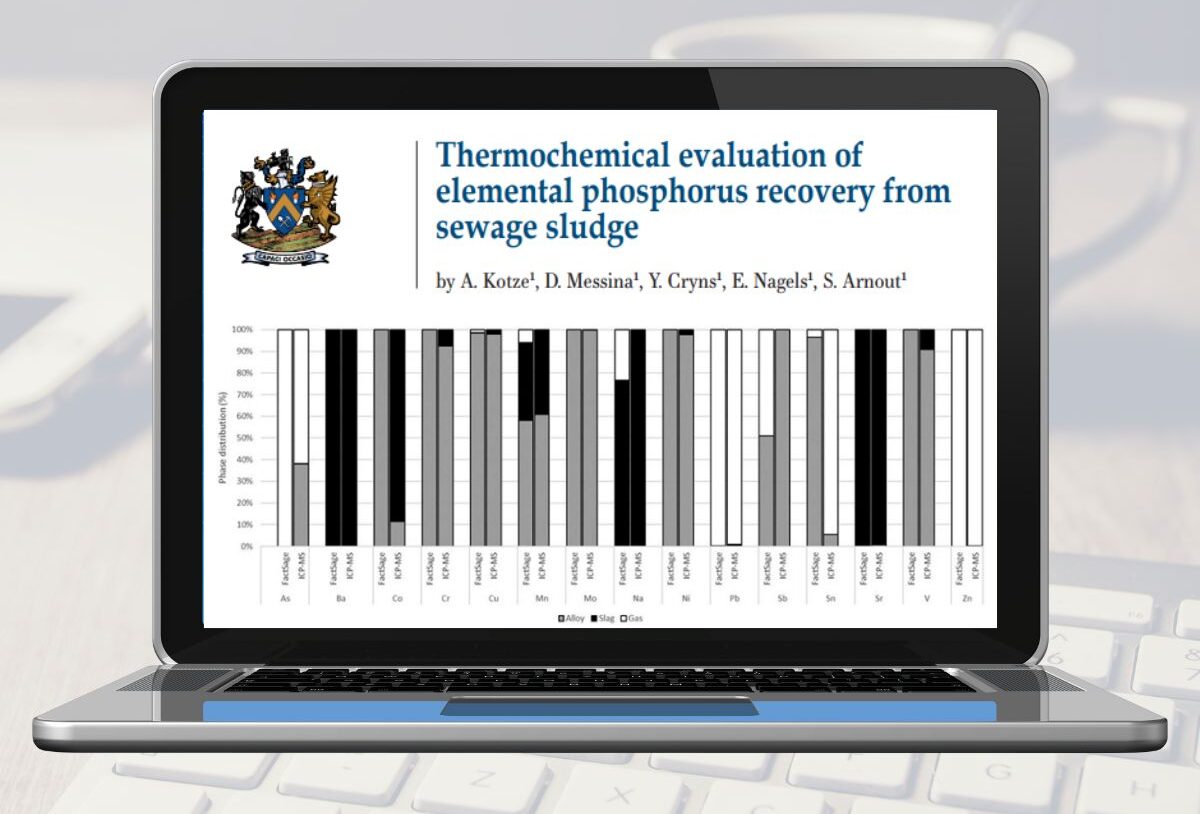
A recent scientific study by researchers from FlashPhos partner Inspyro, published in The Journal of the Southern African Institute of Mining and Metallurgy, offers an important thermochemical evaluation of this process. While the reactors are already being tested, this work aimed to deepen the understanding of the chemical reactions at the heart of the FlashPhos technology, validating the process and identifying key factors for optimisation.
The Focus of the Study
The research examined the material behaviour during phosphorus recovery from sewage-sludge ash under high-temperature, reducing conditions, the same principle that drives the FlashPhos process.
In both FlashPhos and the published study, carbon acts as a reducing agent in a high-temperature furnace (~1600 °C), breaking down phosphorus-bearing compounds in the ash. The phosphorus is then liberated as gaseous white phosphorus (P₄), which can be condensed and collected for reuse in industry.
The researchers combined thermodynamic modelling with lab-scale experiments, providing valuable data on how real sludge ashes behave under FlashPhos-like conditions.
Key Results
- Feasibility confirmed: Sewage-sludge ash can successfully serve as a feedstock for elemental phosphorus production.
- High phosphorus yields: Depending on the ash composition, up to 75 % of the phosphorus was recovered as P₄ — closely aligning with thermodynamic predictions.
- Composition matters: The iron-to-phosphorus ratio strongly influences efficiency; reduced iron content increases phosphorous yield.
- Clean by-products: The resulting slag contained few heavy metals, showing potential for use in cementitious materials.
- Minor challenges: Some volatile metals (like zinc or lead) co-evaporated with phosphorus, pointing to the need for downstream purification.
Why this matters for FlashPhos
This study provides scientific validation for the thermochemical foundation of the FlashPhos process. While FlashPhos is already being realised and tested, this research served as inputs into the process development and explains why and how the process achieves its results, and where fine-tuning can make it even more efficient.
It confirms that:
- sewage-sludge ash is a viable, scalable feedstock for P₄ recovery,
- the reduction chemistry performs as intended,
- and by-products like slag can be safely reused, supporting circularity.
In short, this study strengthens the confidence that FlashPhos’s technology is on the right path – scientifically sound, technically feasible, and environmentally promising.
Looking Ahead
As FlashPhos continues its test and demonstration phase, insights like these are vital. They help engineers and researchers optimise reactor design, control temperature profiles, manage impurities, and ultimately prepare for industrial-scale rollout.
The vision remains clear: a closed phosphorus loop, where Europe produces its own elemental phosphorus from waste – securing critical raw materials while reducing environmental impact.
This blog article was developed on the base of a scientific paper of FlashPhos partner Inspyro. Read it here.