
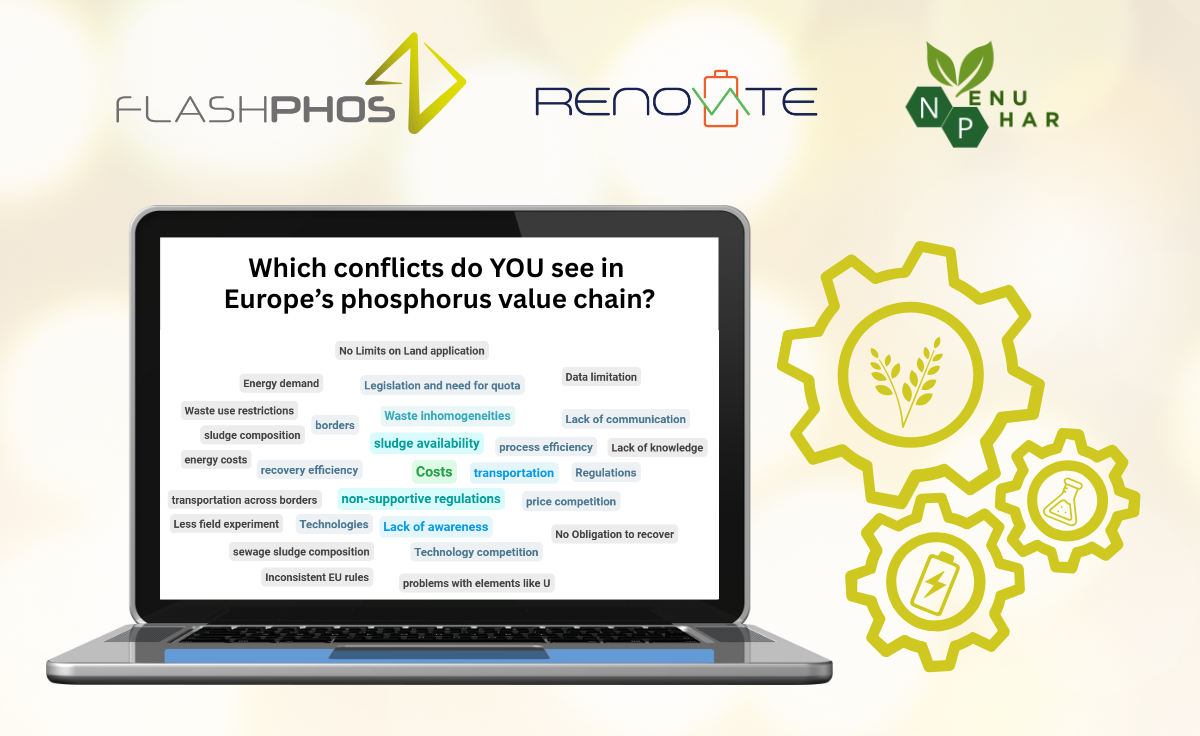
Europe faces growing pressure to secure access to phosphorus – a critical raw material essential for both food production and clean energy technologies. Insights from a recent expert workshop show that circular solutions such as the EU-funded FlashPhos project can help reconcile agricultural and industrial demand while reducing Europe’s dependency on imports.
Phosphorus has long been associated with agriculture, where it is indispensable for fertilizers and global food security. Today, however, its importance extends far beyond the field. High-purity phosphorus compounds are vital for lithium iron phosphate (LFP) batteries, flame retardants, electronics, and renewable energy systems. As Europe accelerates electrification and energy storage deployment, demand for phosphorus is rising sharply.
This dual role has sparked debate over a potential “food versus energy” conflict. According to experts participating in a recent online workshop, this perceived competition is largely misleading. Agriculture still accounts for around 85–90% of global phosphate consumption, while industrial and energy applications represent a smaller but rapidly growing share. Crucially, both sectors depend on the same vulnerable supply chains.
A Strategic Vulnerability for Europe
The European Union currently has no active phosphate rock mines and relies heavily on imports, mainly from Morocco and Russia. Geopolitical tensions and supply disruptions expose significant risks for food production, battery manufacturing, and industrial value chains alike. While phosphorus itself is abundant in the Earth’s crust, high-quality, easily accessible phosphate rock is limited and environmentally challenging to extract.
These shared vulnerabilities underline the need for resilient, European-based phosphorus value chains.
Circularity as the Way Forward
Workshop participants highlighted circular phosphorus systems as the most effective solution. Several EU-funded projects demonstrate how waste streams can be transformed into valuable secondary raw materials.
The FlashPhos project stands out by converting phosphorus-containing waste, primarily sewage sludge, into elemental white phosphorus (P₄) – a universal precursor for fertilizers, batteries, flame retardants, and chemicals. Using a three-step process involving drying and grinding, flash reactor treatment, and electrical refining, FlashPhos can recover up to 300,000 tonnes of white phosphorus from waste streams. This has the potential to significantly reduce Europe’s current import dependency, which stands at approximately 30,000–40,000 tonnes per year.
In addition to phosphorus recovery, FlashPhos generates valuable by-products such as iron alloys and high-temperature process heat, further improving resource efficiency and industrial integration.
Complementary initiatives such as NenuPhar, which focuses on nutrient recovery from manure and wastewater, and RENOVATE, which enables circular recycling of LFP batteries, illustrate how agriculture, waste management, and energy technologies can be linked into a coherent circular economy.
Policy and Coordination Are Key
Experts emphasized that technology alone is not enough. Clear and binding regulatory frameworks are essential to provide investment security and enable large-scale deployment of recycling technologies. While current EU legislation encourages nutrient recovery, mandatory targets, quota systems, or certificate-based mechanisms could accelerate market uptake of secondary phosphorus.
Coordinated action across industry, policymakers, and waste producers – supported by data-driven mapping of phosphorus-rich waste streams – is critical to building stable, long-term circular value chains.
From Bottleneck to Opportunity
The workshop concluded that phosphorus is not a question of food versus energy, but a shared strategic challenge. By scaling proven circular technologies such as FlashPhos, aligning policies, and fostering industrial collaboration, Europe can turn phosphorus into a resilient, circular resource.
This transformation would strengthen food security, support the clean energy transition, and reduce environmental impacts – ensuring that phosphorus remains a cornerstone of Europe’s sustainable future.
This article builds on the discussions and expert contributions from an online workshop organised under the EU-funded FlashPhos project. The complete recording of the session, including the panel discussion and audience interactions, is available here.